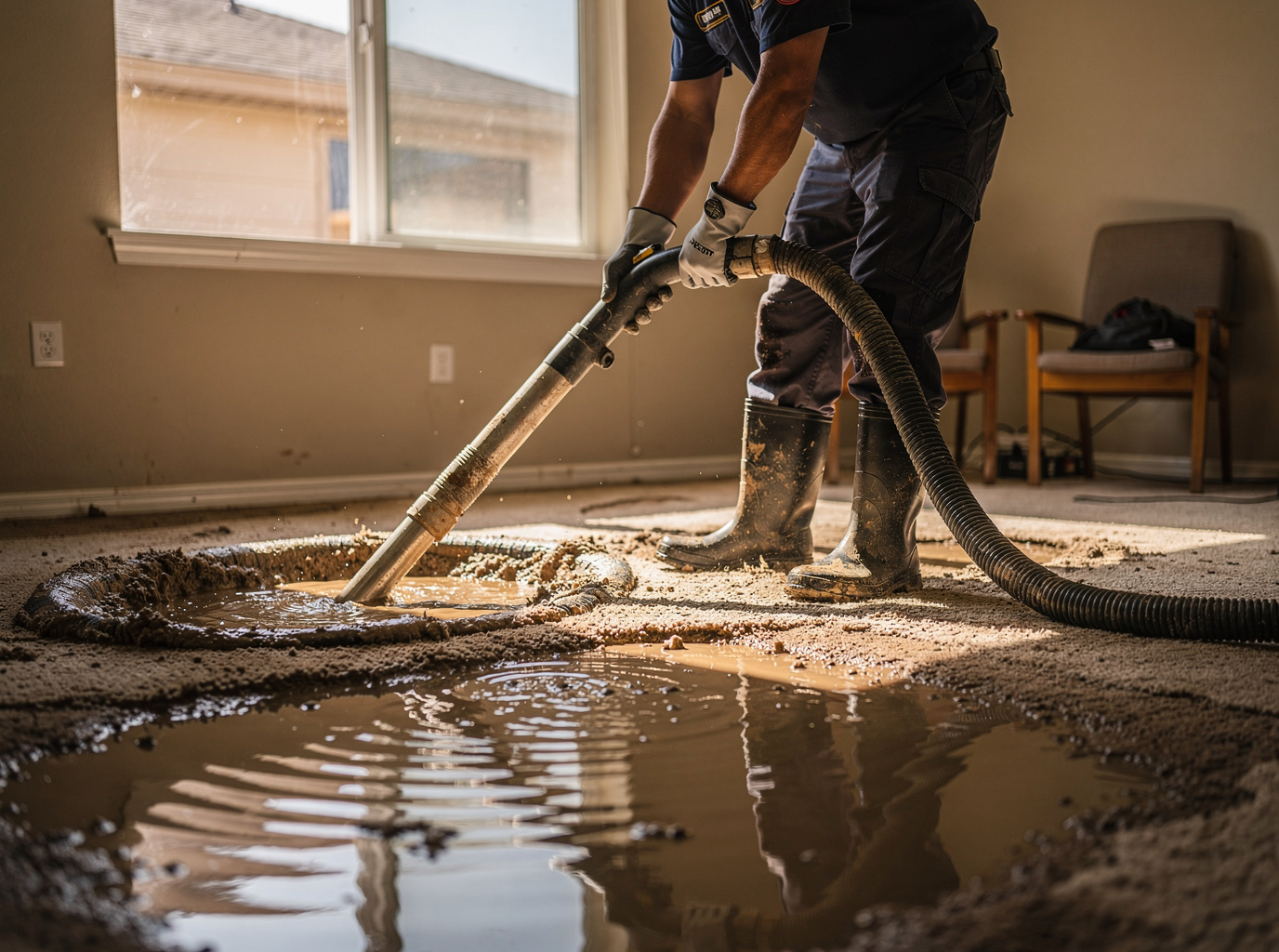
Laredo’s hot semi-arid climate means summer temperatures often push past 100 degrees, so standing water from a burst line or roof leak evaporates quickly on the surface but leaves hidden moisture in wall cavities and under slab foundations common in older Downtown and San Agustin Plaza homes. Technicians must pull baseboards and use moisture meters on brick and stucco walls to locate pockets that would otherwise feed mold within days. Webb County soil is heavy clay that holds water against foundations, so exterior grading and French drains frequently become part of the same job.
Many homes in Del Mar and Hillside were built before modern vapor barriers, so carpet pad and hardwood on slab can trap water that travels under partitions into adjacent rooms. Extraction crews use truck-mounted units rated for 200-plus gallons per minute followed by low-grain dehumidifiers sized for 1,200-square-foot spaces to stay ahead of the humidity spike that hits when monsoon moisture moves up from the Rio Grande. Failure to address both the liquid and the vapor layer is the most common reason return visits occur in these neighborhoods.
Los Presidentes and nearby subdivisions built in the 1980s and 1990s often have polybutylene or early PEX supply lines that split under pressure during the brief cold snaps that still reach the area. When a line fails at 2 a.m., crews arrive from the 1601 Jacaman Rd shop, isolate the water at the meter, and begin extraction before the water migrates into adjoining garages or laundry rooms. Documenting every step protects homeowners when insurance adjusters later question the scope.
Technician insight
In Laredo the thing that catches most people out with Emergency Water Removal is how quickly the hot semi-arid air dries the visible surface while clay soil and older slab construction keep moisture trapped under tile and behind baseboards in neighborhoods like Hillside and Downtown.
Washing-machine leak in Del Mar
A homeowner in Del Mar noticed water seeping from under the laundry room wall after an overnight hose failure. Extraction crews found water had traveled under the tile into the adjacent hallway and bathroom. They removed baseboards, extracted under the slab edge, and ran drying equipment for four days until readings matched unaffected areas.
Emergency Water Removal Services We Offer
✓Burst Pipe Water Extraction
Immediate removal of pressurized water from supply-line failures in older Laredo plumbing before it reaches subfloors or shared walls.
✓Appliance Leak Cleanup
Extraction and drying after washing-machine, water-heater or refrigerator leaks common in slab-on-grade homes throughout Del Mar and Hillside.
✓Storm Water Removal
Rapid pumping of rainwater that enters through flat roofs or low window wells after heavy summer downpours in Webb County.
✓Ceiling and Wall Cavity Drying
Targeted extraction of trapped moisture behind drywall and in attic spaces after roof or second-story leaks in Los Presidentes homes.
✓Slab Leak Water Removal
Floor-level extraction and moisture mapping when supply lines under concrete slabs fail, preventing hidden damage to tile and hardwood.
Emergency Water Removal Cost in Laredo, TX
| Service | Typical Range | What Affects It |
|---|---|---|
| Single-room extraction and drying | $350–$750 | Varies with carpet vs. tile and whether wall cavities are involved |
| Whole-house flood extraction | $1,200–$2,800 | Driven by square footage, water depth, and number of dehumidifiers required |
| Slab leak moisture mapping and drying | $600–$1,400 | Includes floor scans and extended equipment runtime |
| After-hours or weekend response | $150–$300 | Added to base job when call comes outside Mon–Fri 8–6 or Sat 9–2 |
Ranges are typical for Laredo, TX and confirmed with an exact written quote before any work starts.
How it works
- 1
On-Site Assessment
Technician arrives, locates the water source, maps affected rooms with moisture meters, and determines extraction equipment needed for the property’s construction type.
- 2
Water Extraction
Truck-mounted and portable pumps remove standing water from floors, carpets and cavities while protecting unaffected areas with containment barriers.
- 3
Drying And Dehumidification
Air movers and commercial dehumidifiers are positioned to pull remaining moisture from walls, subfloors and contents until readings reach pre-loss levels.
- 4
Final Verification
Moisture readings are rechecked, equipment is removed, and a written drying log is provided for insurance or homeowner records.
Pricing
Most emergency water removal jobs in Laredo fall between a few hundred and a couple thousand dollars depending on water volume and how many rooms are affected.